We’re back with another weekly report of encounters with whales and wildlife across the central Salish Sea. This report covers our trips and our sightings that occurred from July 27th through August 2nd.
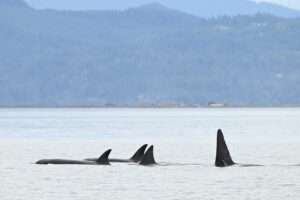
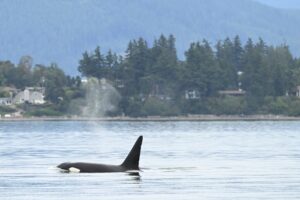
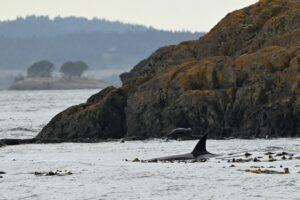
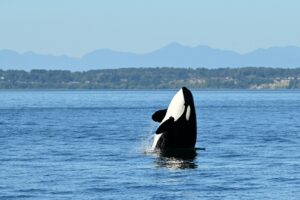
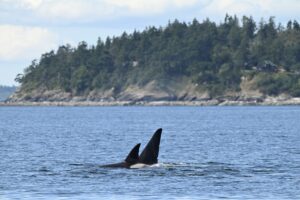
Bigg’s killer whales that were sighted on our tours around the central Salish Sea the past week include: the T30 siblings, T30A and T30C (2), the T35As who are still traveling with the T38As (9), T36s (6), T37A and T37A2 (2), T69E, T75Bs (4), T77C & T77E (2), T100s (3), T137A, and a super rare, VERY notable sighting of a trio of California Transients known as the CA027s/T135s (we’ll talk about that next) for a total of 33 individuals. The T36s and T137A spent multiple days in and around the Bellingham Bay and Samish Bay area, mostly eating their way through the area as they went, but they were also the “tour guides” for the rare trio their first day with us! Definitely nice to have the T36s back after what has felt like a really long absence on whales we tend to see more regularly.
Now for the CA027s/T135s. Why the two different designations for the same group? First, these whales have been sighted most frequently between Monterey Bay and the Channel Islands than anywhere else along the West Coast Transient killer whale range, and have been documented by researchers down in that area who keep up with California Transients (basically a subset of the overall Bigg’s/Transient killer whale population). If California Ts are seen in other areas throughout their range, like the Salish Sea for example, and meet the number-of-times-spotted criteria put in place by local researchers, they also receive a “T” designation and are added to the catalog that Bay Cetology (out of British Columbia) keeps. If these whales were to ever wander all the way up to Alaska and meet researcher criteria up there, they could also receive an “AK” Transient designation! Anyway, we’re never sure why whales choose to cruise in new areas, and we don’t know the full extent of some of their associations and relationships with one another, so both the fact that this trio came into our area AND they were spending time with the T36s, T69E, and T137A were surprising! But, if you’re going to travel somewhere newer to you, it’s probably smart to have “the locals” show you around. The first day we encountered the CA Transients, they were with friends and popped under Deception Pass bridge to skulk around the shallows of Similk Bay. At times, these whales were only in 10-12′ of water! T135C and T137A could not get their dorsal fins completely submerged in the water, that’s how shallow they were patrolling. They never did hunt anything during that encounter, but they were pretty fun to watch. The next day, the CA027/T135 trio had split from the rest of the whales and were traveling south in Rosario, eventually headed due west back for the open Pacific. Their time in our area proved short. It will be interesting to see when and where they are documented next!
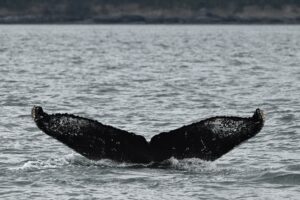
We continue to have humpback encounters and some minke whales every once and a while. There was also a trip to the southern reaches of Saratoga Passage, between Whidbey Island and Everett, where several “Sounders” gray whales were encountered. Our humpbacks sighted include: BCX2081 “Bandit,” BCY1289 “Monsoon,” BCY1335 “Billiard,” and BCX0519 “Stitch.” Gray whales include: CRC-53 “Little Patch,” and CRC-2686 and CRC-2687, neither of which have nicknames yet!
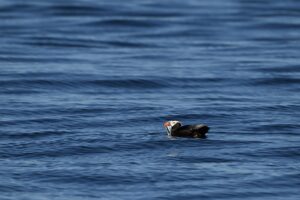
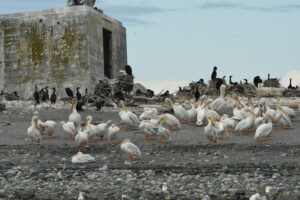
Some other notable wildlife sightings this week happened when we were able to get out to the Smith and Minor Island areas for Tufted Puffins and some rare-to-our-area American White Pelicans! While we don’t even see many Brown Pelicans inside the Salish Sea (they are primarily a coastal species), it’s even more rare to encounter the White variety; they tend to occupy more inland/fresh water areas. The group of American White Pelicans we did have was rather large and they seem to prefer hanging out along the spit at Minor Island. We’ll see how long they decide to take up residence at that location.
We look forward to what this next week has to offer!