Another week has somehow come and gone! Here is this week’s recap of whales and wildlife encountered on tours ranging from August 31st to September 6th. There’s just something about the lighting and the overall feel as we shift from late summer into early fall. Temperatures drop off, the sun is starting to angle a bit, creating glorious evenings. If you’ve never been out on the water around here in fall, you should absolutely consider it!
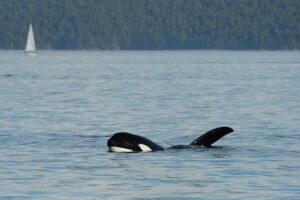
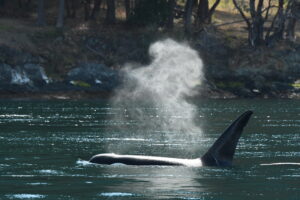
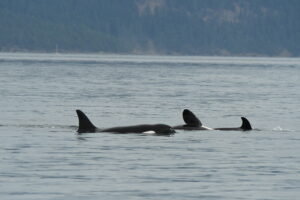
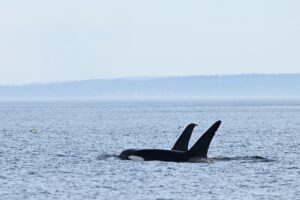
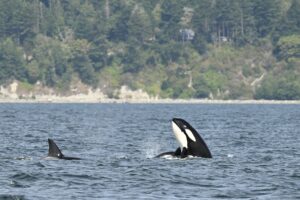
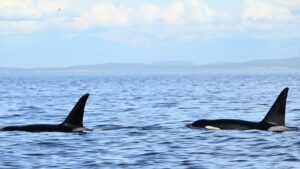
For our Bigg’s killer whale recap, we encountered the following family groups over the last week: the T19 trio, T36s (6), T46Bs (9), T49As (6), T49A2 traveling with T65A3, brothers T60D and T60E, the 65Bs (4), the T100 trio, T123s (4), and T137A “Jack,” making for 40 individuals. We hadn’t seen T49A2 in quite a while and to have him traveling with T65A3 was an absolute treat. Several summers ago, these two boys were off on an adventure and basically munched their way throughout the San Juan Islands, earning themselves the nickname “The Butcher Boys.” Well, a couple years have gone by, and it seems now they’re checking in with each other again! During one of our encounters, they were traveling with T137A “Jack” and the T36s, making for three very distinct, very impressive dorsal fins to pick out of the group.
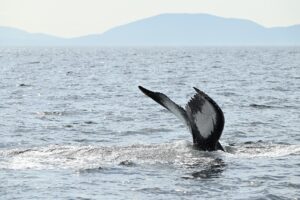
On a few of our runs into the southern portion of the Strait of Georgia we saw humpback whales. From those that we could identify (using the underside of the tail flukes) we had BCY0414 “Zephyr,” and very likely Divot and her 2026 calf, though we didn’t get the angle on the photos we needed to be 100% sure. Others were social, in small groups or duos, and were definitely feeding up near the Fraser River Delta, but again, just not “fluking” to reveal who they were.
A couple minke whales were also seen foraging on bait fish off the south end of the San Juan Islands. These elusive whales can be quite entertaining to watch as the scatter groups of birds and lunge toward the surface to scoop up the fish.
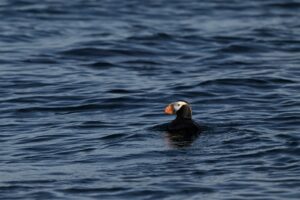
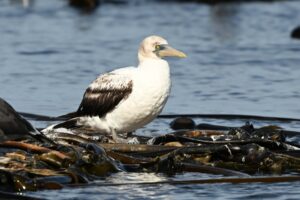
As far as other wildlife sightings this week: we had an incredible feathered visitor to the Salish Sea–a Nazca Booby! These birds range off of the southern tip of the Baja California Sur Peninsula in Mexico to off the coast of Peru, breeding in the Galapagos Islands. What this individual was doing on a PNW jaunt is anyone’s guess! After the bird was initially found in the Strait of Juan de Fuca, it moved east and settled out along the kelp beds near Smith Island for a few days. We were lucky enough on one evening trip that the calm weather and the direction of some orcas brought us to the vicinity of Smith Island. We combed the kelp beds and sure enough this young bird was tucked in near a couple of Heermann’s gulls. As it often happens in the fall, we experienced a strong wind storm that pushed in from the Pacific shortly after our encounter, and no one has been able to relocate the bird since. But it just goes to show we really never know what might show up around here! Tufted Puffins are still out along Smith Island as well and are beginning to lose their breeding plumage–their white facial feathers, some of the bright orange keratin on their beaks, and their tufts are really starting to thin out. They’re going to want to blend in with their environment and are gearing up before they make the push west. We’re coming to that time of year where we’ll wish them well out over open ocean and wait for them to arrive again in late April/early May looking their best!
As always, we look forward to seeing what next week has to offer us!