Another weekly recap is upon us! Autumn has clearly arrived, winding down longer, warmer, summer days, but the whale and wildlife activity is still quite abundant in the central Salish Sea. Here is what we encountered across our trips that ran September 28th through October 4th:
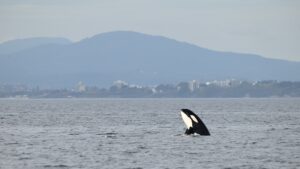
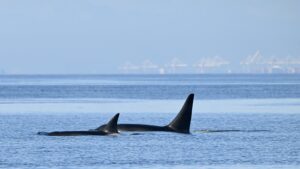
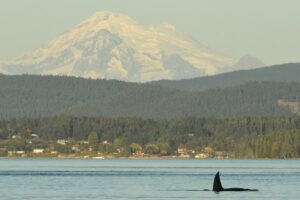
Bigg’s killer whales that we encountered over this last week consisted of: the T19 trio, the T30A & T30C siblings, T36A1s (with a brand new calf–T36A1B–SO cute!) making them a trio now, T37Bs (3); the T46Bs were all back together (9), the T49As popped back into the Salish Sea and had two (presumed) extended family members with them–T50B1 and T50D (whales we don’t see around the central part of the Salish Sea with much regularity), making them a group of 8. T49C was traveling solo, the T60 brothers (D&E) were around for a bit, the T65Bs (4) made an appearance, as did the T109As (6). Last, but certainly not least, the rest of the T137s (3) FINALLY came back into the Salish Sea and were seen on September 26th for the first time since early June! When they will meet back up with Jack (T137A), only time will tell, but it was definitely good to see them after their extended absence. This makes for a grand total of 44 individuals we personally encountered on trips during this time span.
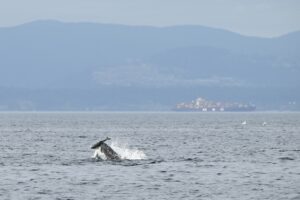
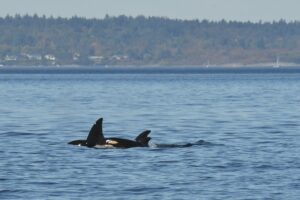
A notable encounter occurred with the T46Bs just southwest of Victoria. T46B3 “Sedna” and her 1.5 year old son, “Munro” (T46B3A) had slowly turned away from the main group of T46Bs, and after making their way parallel to them (by roughly a mil apart), their behavior suddenly changed and became a bit more erratic at the surface. They were chasing a harbor porpoise! What was incredible about this encounter was that Sedna made contact with the porpoise first, punting it off of her rostrum (nose) above the surface, but the next pass was little Munro mimicking that exact behavior and also successfully making contact with the porpoise! Sedna spyhopped a couple times just after that, possibly checking to see where Munro and the porpoise were, nearby, but soon after things calmed down and the whales began prey-sharing. As an apex predator, no doubt that orca calves start learning hunting tactics when they’re very young. While we feel for the porpoise, everyone has got to eat, and it’s encouraging to see this pair doing so well since Sedna may soon choose to disperse away from her mother’s family group and start building her own matriline. At least we know they’ve got the skills to keep themselves fed.
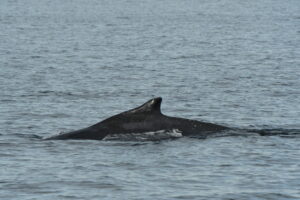
There were a few humpbacks that were spotted around the San Juan Islands, and those that we were able to identify include: CRC-22818, CRC-23332 (no nicknames yet), and a whale that, upon upload to HappyWhale.com was deemed a whale never recorded and “new to science.” Their given designation is now HW-MN0510951. It’s amazing that there still might be whales making their way into the Salish Sea that have never been photographed and recorded before, so anytime it happens it’s always an amazing chance to talk about research efforts with folks on board. You never know when you get an underside fluke photo that might produce the first looks at an unrecorded humpback whale!
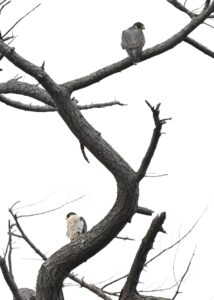
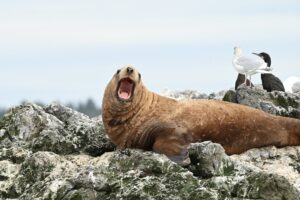
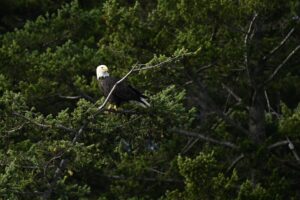
Steller sea lions are still settling in to winter with us, and fall birds are arriving. We’ve had several common loons taking up residence just outside out marina, and small flocks of snow geese and cackling geese are pushing in from Pacific. They, too, will be here until things warm up, up north, again. We’ve had a few trips with lots of eggyolk jellies being carried by the tides, and our token sea otter has been around, too. This past week we spotted a peregrine falcon pair that got the whole boat talking. We’ll be keeping our eyes peeled for both the usual and unusual through the rest of our season!
As always, we look forward to seeing what next week has to offer us!