We’ve wrapped up another wonderful week out on the Salish Sea, and it’s possible we experienced close to every PNW season over the last seven days! From cold, drizzly days, to sunny but windy ones, each weather swing really enhanced the adventure. All that said, the weather didn’t deter the wildlife, so here is our sightings recap for tours we ran from July 6th through July 12th:
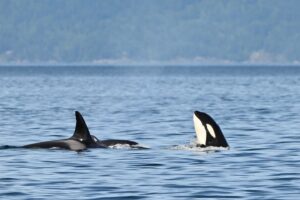
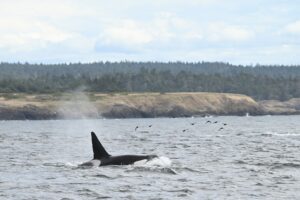
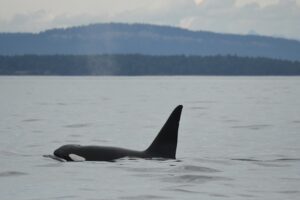
Bigg’s killer whales keep cruising around and through the central Salish Sea, with some family groups spending more time meandering around than others. Bigg’s matrilines we encountered are as follows: T37A and T37A2 (2), the T37Bs (3), T46Bs (6), T46B3s with T46B6 (3), the T49As (6), a recently dispersed pair of brothers T77C & T77E (2), T100s (3), T101s (3), the T123s (4), and T137A “Jack” all on his own (new development). In total, 33 different individuals were encountered by our tours, but by far we spent the most time with the T46B family of 6.
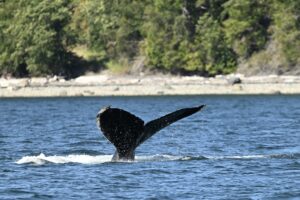
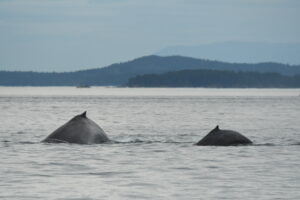
Gray whales were encountered by almost all of our tours throughout this last week, and several were also treated to some humpback whales. Gray whale CRC-2702 was seen on multiple trips, as well as two unidentified gray whales. Humpback whale MMX0099 “Gretzky” was seen feeding off of some of the reefs just outside the Deception Pass area for several days, but is likely perusing another nearby buffet. It’s not uncommon for certain individuals to be seen for several days, go a length of absence, and then possible be picked up again in other areas later on in the season. Humpback whale BCX1057 “Divot” was also spotted with her 2026 calf, and one more humpback whale will be our notable encounter for the week, outlined next!
Our notable encounter this week involved a humpback whale nicknamed “Kiarra Kelly.” Not only was the sighting quite curious and amazing, but learning more about the story behind the nickname was really interesting, too. We were able to spend time with this individual humpback just off the west side of Lummi Island–and when I say just off the west side, I mean that whale was CLOSE to shore as it swam along. Multiple times little rings of bubbles were observed beneath the surface, with this whale popping up several yards away a minute or so after. Bubble net feeding has not yet been seen in the Salish Sea, but is a feeding technique that small groups of whales participate in to corral forage fish in other parts of the Pacific, most notably up in Alaska and along the BC coast. It is a behavior that is not inherent, so must be learned through social transmission. We figure at some point in the future we may see some of the humpbacks that feed here start doing it, but the technique has not yet been passed along in our area. So to see what appeared to be an attempt at solo bubble-netting was pretty darn cool! Now, for the name “Kiarra Kelly.” There is a wonderful article published by the Oceanic Society about how the name came to be, found here: https://www.oceanicsociety.org/news-and-announcements/the-humpback-whale-named-parker-kelly-how-an-nhl-stars-honeymoon-started-a-conservation-wave -but the gist was that Colorado Avalanche hockey player Parker Kelly and his wife experienced the humpback whales in Hawaii during breeding and calving season, and they did not just become fans of whales. They literally became obsessed with whales. Parker shared the story during a locker room interview, and that small spark sent Colorado Avalanche fans on a fundraising spree. The goal? To send the money raised to the Oceanic Society to support humpback whale conservation and to also adopt and name a humpback whale after Parker in the process. The fundraising event was so successful that the fans were able to adopt a second humpback whale. The pair was named for Parker Kelly and his wife Kiarra Kelly. Really cool to encounter a humpback whale with such an amazing conservation and love-for-whales-at-first-experience story to go with them. A testament that not just the experience of these big, beautiful creatures, but also the story that goes along with some of them really connects people to conservation efforts ensuring they are around for a long, long time.
We’re looking forward to seeing what the next week brings us on the wildlife front and hope you can join us!