Another week of whales and wildlife has flown right by us, and so we bring you the sightings recap from our tours that ran June 22nd-June 28th:
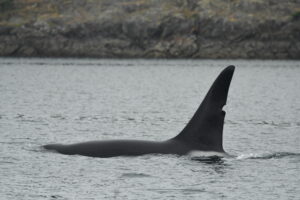
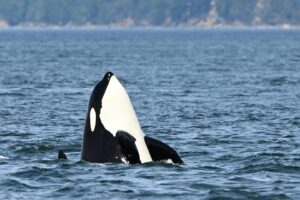
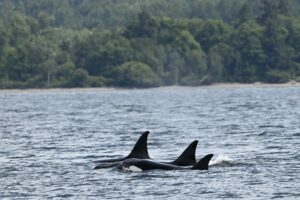
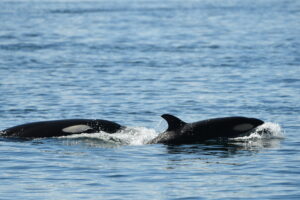
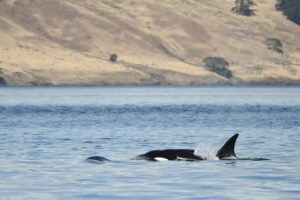
I know I say this in almost every weekly recap throughout our summers, but Bigg’s killer whale presence is still going strong throughout the central Salish Sea–where there’s an abundance of food, they will peruse! This has given us the opportunity to introduce many people to their first wild killer whales. Family groups (matrilines) that we encountered over our tours this past week include: the T37Bs (3), T46Bs (9), T49As (6), T49Bs with T50D (4), the T65Bs (4), the T75Bs with T77D (5), T100s (3), T123s (4) which seemed to have a different group of friends on our multiple encounters of them: T124A2s (3), T124A4s (3), for example–making for 44 individuals over the course of the last seven days! To note, the T65As and T64Bs have parted ways with the T64Bs heading north and out of the Salish Sea. What an interesting run for that group! I wonder when we’ll see them again…
Also of note: as we were on our evening tour on the 25th, guests and crew witnessed a very rare event unfolding. The T37B family (3) were in pursuit of a minke whale as we were approaching for viewing. T37B was porpoising out of the water at high speed, but the minke whale was faster, out-pacing her and only a half-hearted attempt made by her son, T37B1. After pulling ahead of the orcas by half a mile, then a mile, T37B turned back north to reunite with a now-lagging T37B1 and her daughter T37B3. After the attempt, the group slowed down into a resting pattern. It is not often this kind of predation attempt is witnessed, mostly because we have a very small (20-24 individuals) population of minkes and Bigg’s killer whales have much more abundant prey in seals, sea lions, and porpoise. Definitely an exciting evening to be out on the water.
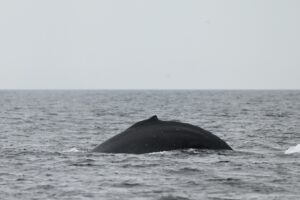
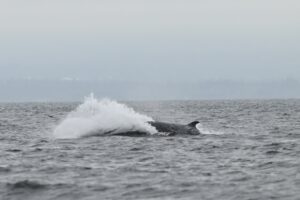
On the baleen whales front, there are still a couple lingering gray whales, including a newcomer to the Salish Sea as of this year, CRC-2702. We saw humpbacks on a couple of our tours, though were unable to make IDs (no tail flukes to go off of). We are hearing there have been good numbers further west in the Strait of Juan de Fuca, so hope to see more of them passing through our area as summer continues.
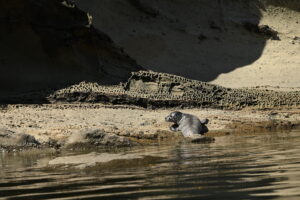
Harbor seal pupping season looks like it is just beginning and we saw our first two small, wrinkly little pups last week! Nursing and weening take place inside a roughly 40-42 day time period, making the growing season fast! This is one of our favorite times of the season to be on the water–they’re so cute!
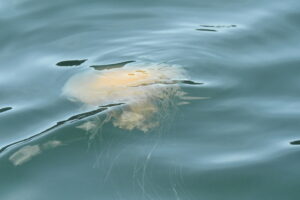
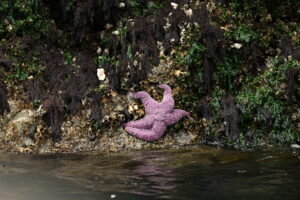
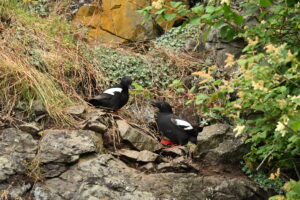
As we continue to experience some of the lowest tides of the year, we are still seeing many intertidal creatures and a plethora of seabirds. Ochre sea stars and hundreds of moon jellies and eggyolk jellies were seen on several of our tours. We caught sight of a tufted puffin in Bellingham Channel this week which is much further north than their typical fishing spots, and they delighted a group of summer camp students we had aboard. On our way back into Rosario after viewing whales off the south end of Lopez, we cruised by a loon that on second glance of the captured photo turned out to be a Yellow-billed loon–a bird typically found in the arctic during breeding season. We’re always keeping our eyes peeled for anything out-of-the-norm while we’re out cruising, and this week turned up some fun and rare wildlife. You really never know what you’ll see each trip out on the water!
We’re looking forward to seeing what the next week brings us on the whale and wildlife front and hope you can join us!